Your passcode
You know exactly one secret. Everything else is machine-generated.
That sentence governs this whole page. There is no master password and a PIN, no recovery phrase, no security questions. One passcode, on every tier.
Why one secret and not two
The app used to ask for two: a master password and a PIN. That looked like two factors. It was not.
The master password was stored wrapped with the PIN — so anyone who cracked the PIN got the master password for free. Its length and complexity contributed nothing to an offline attack. The pair had exactly the strength of its weaker half, and the weaker half was a short numeric PIN.
Collapsing it to one secret removed the illusion and raised the ceiling:
| Before | Now | |
|---|---|---|
| Secrets you type | 2 | 1 |
| Alphabet | PIN was digits only | Any characters |
| Length limit | 12 | None |
| Strength ceiling | The weaker of the two | Your passcode, governed by an entropy rule |
What used to be the master password did not disappear — it stopped being something a human chooses. It is now 256 random bits the app generates, that you never see and never type.
What your passcode actually does
your passcode → Argon2id → a 256-bit secret → unwraps Shard 2
Argon2id is a deliberately expensive function: 128 MiB of memory and 10 passes for a single evaluation. You pay that once, when you unlock. An attacker who has stolen your phone pays it on every guess, which is what turns a modest passcode into a genuinely slow target.
On Titanium the middle step is an OPAQUE export key instead, derived the same expensive way but never stored at all. See Security tiers.
Strength is measured in bits, not characters
A "minimum 8 characters" rule cannot express that eight digits and eight mixed characters are nothing alike:
| Passcode | Possible values | Rough time to exhaust |
|---|---|---|
| 8 digits | 100 million | Hours |
| 8 lowercase letters and digits | 2.8 trillion | Years |
| 8 mixed case with symbols | 4.3 quadrillion | Thousands of years |
So the requirement is expressed in bits of entropy, and the length you need falls out of the alphabet you chose:
| If you use | You need about |
|---|---|
| Digits only | 14 characters |
| Lowercase letters | 10 characters |
| Lowercase and digits | 9 characters |
| Mixed case | 8 characters |
| Mixed case with symbols | 7 characters |
45 bits is the floor — below it the app will not let you set a passcode. 60 bits is the target it nudges you towards.
A passcode made only of digits has to be longer. One drawn from a wide alphabet has earned the right to be shorter. Both land at the same real strength.
The estimate is deliberately crude
Counting characters in an alphabet assumes you picked them at random. Real
people pick words, dates and keyboard runs. The app claws back the most obvious
cases — repeats and ascending or descending runs — so 1111111111111 and
abcdefghij do not pass on length alone.
It is not a password cracker's model and is not meant to be. Treat 45 bits as a floor that blocks the clearly bad, not as a promise about the clearly good.
Choosing one you will not forget
This is the part that actually loses vaults. Not attackers — forgetting.
- A passphrase beats a password. Four or five unrelated words clear 45 bits comfortably and survive being typed on a phone keyboard.
- Do not reuse a passcode you use elsewhere. If it appears in a breach dump, the entropy estimate above becomes meaningless.
- Write it down and store it somewhere physically safe if that is what it takes. A passcode in a locked drawer at home is a far smaller risk than a passcode you are relying on remembering in six months.
If you forget your passcode, the vault cannot be opened. Not by support, not by us, not by anyone. Your passcode never reaches our servers, so we have nothing to check it against and nothing to reset.
This is the direct cost of a key we genuinely cannot access. Please decide now how you will remember it.
Where you create it
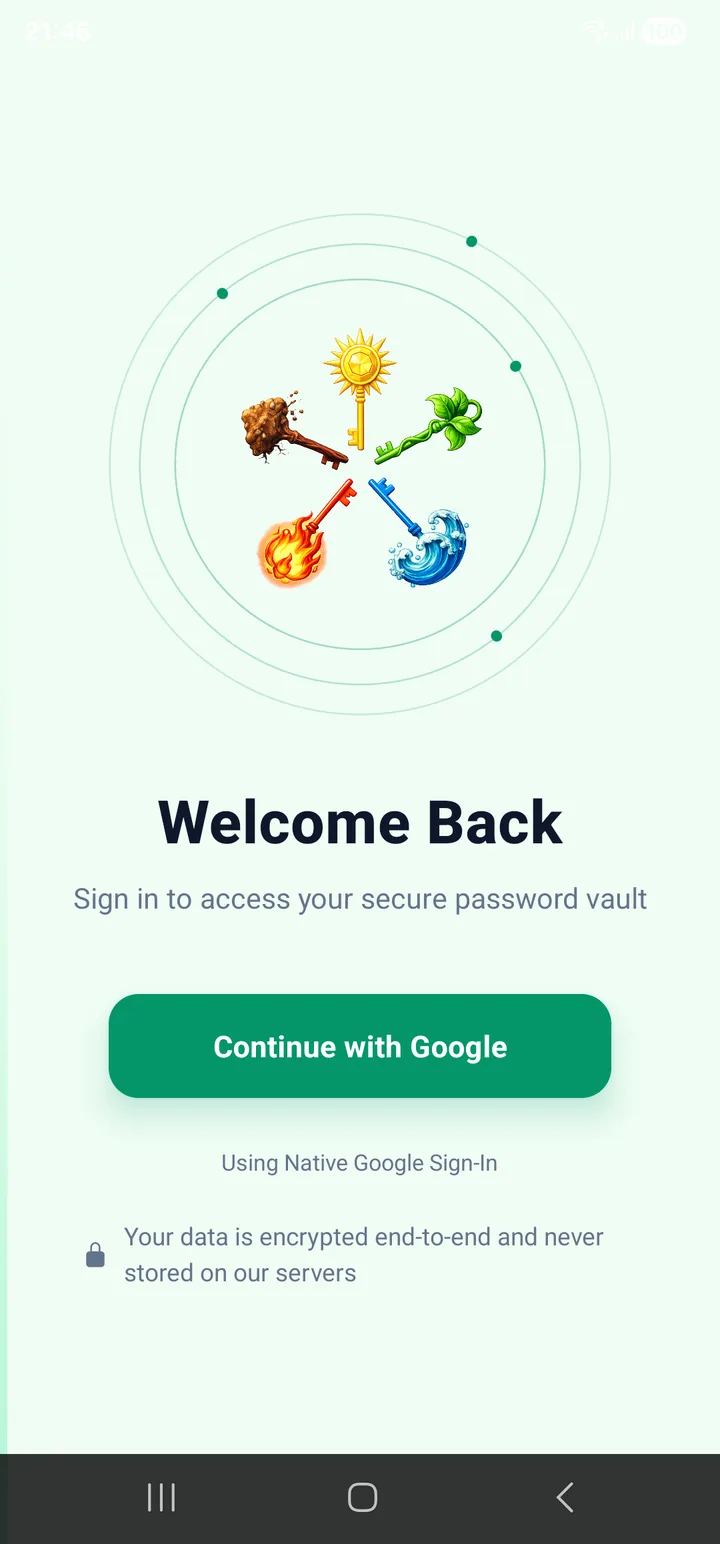
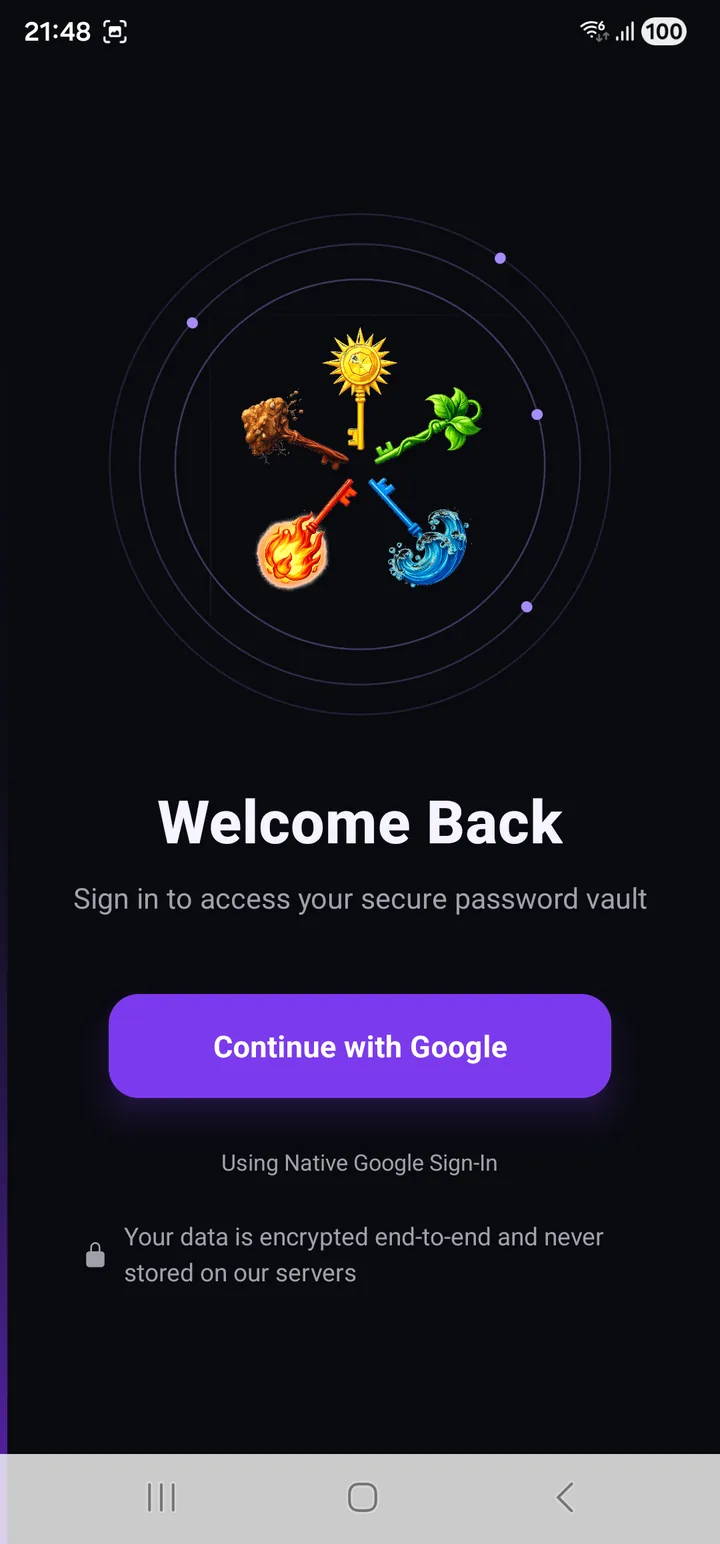
You sign in with Google first. That establishes which account the vault belongs to — it does not, on its own, open anything.
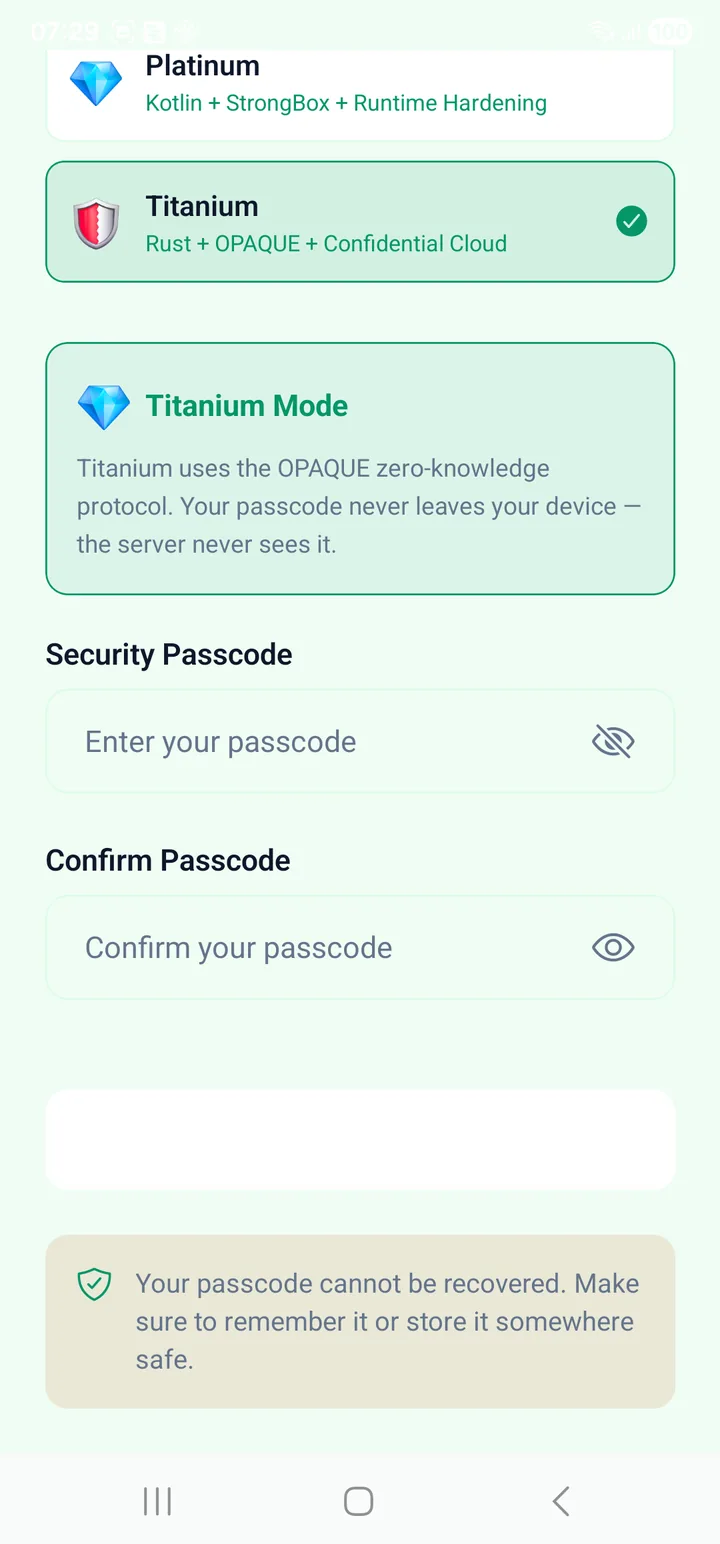
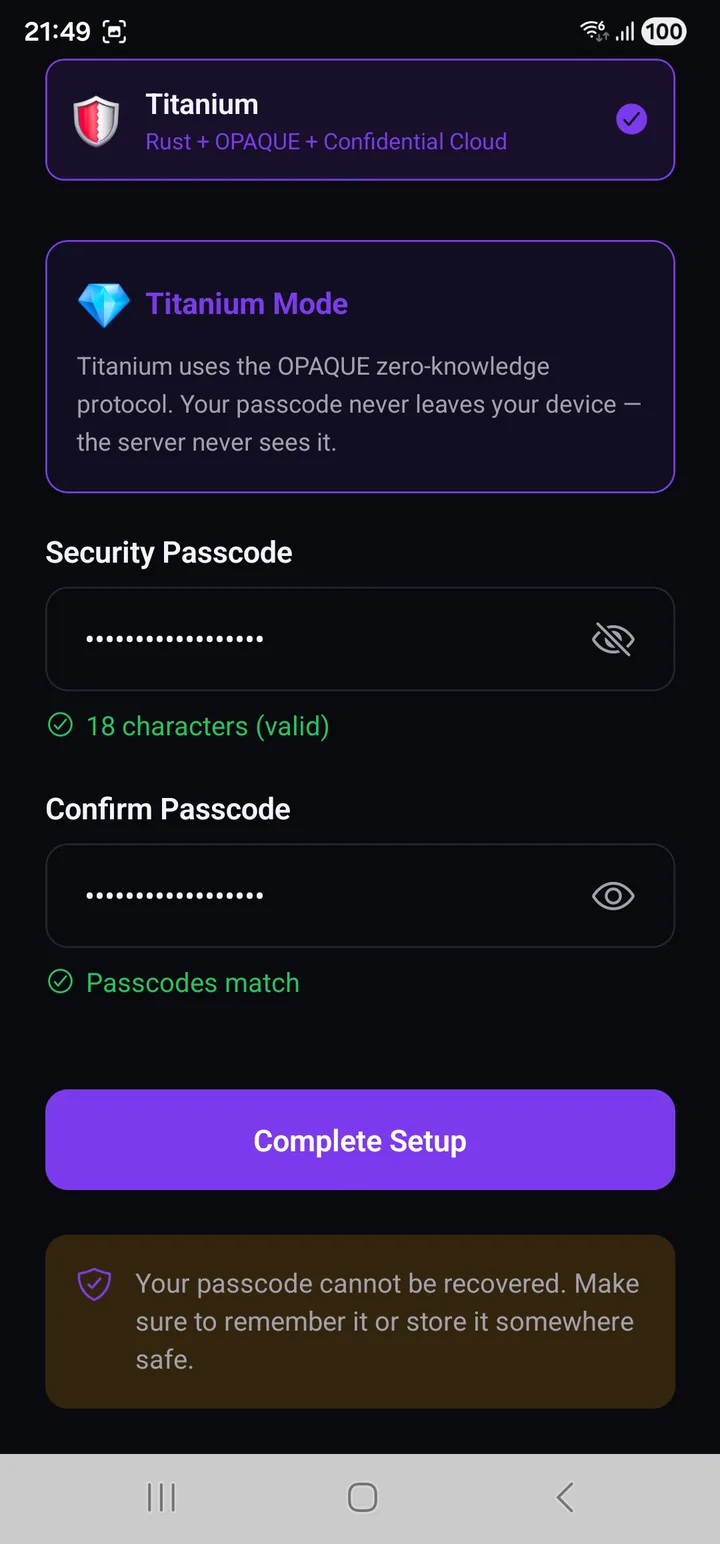
Then you set the passcode, and the app counts the characters as you type. Below the button is the sentence this whole page exists to explain:
Your passcode cannot be recovered. Make sure to remember it or store it somewhere safe.
That box is not legal cover. It is a statement about the mathematics, and it is the reason the rest of the app can make the promises it makes.
Changing it
Changing your passcode is fast and safe. It re-wraps the machine-generated secret; the DEK itself does not change, so none of your stored passwords are re-encrypted and existing backup files stay valid.
What happens to the files you already have:
| Backup files | Left exactly as they are. A backup made before the change still restores after it. |
| Export files | Re-encrypted with your new passcode — all of them, in every place you keep them: the phone's storage, your My Drive, and the app's private Drive area. |
| Anything deleted | Nothing. |
That last row used to read differently. Changing your passcode once kept only your newest export and deleted the older ones "for security", and deleted all of them if you declined the re-encryption. That protected against nothing — an export still locked with your old passcode is not a leak, and the passwords inside it are separately encrypted with a key that never leaves your phone — so it has been removed. Tidying up old files is your call, in the Backup screen.
This is the same on every tier, Silver included.
One small asymmetry, on purpose
Setting a passcode enforces the entropy rule. Entering one only checks that it is not empty.
That is required, not sloppy. Any entry-time rule stricter than the set-time rule could reject a passcode the setup screen accepted — which is exactly how a vault becomes permanently unopenable.
Read next
- How it works — what the passcode ultimately unlocks
- Security tiers — how the chain differs on Titanium
- Autofill — where you will be asked for it day to day